LandOnEarth
AI-powered decision system translating lifestyle preferences into structured home-matching intelligence.
Project Context
TIMELINE
2017–2026. HomeMatch core system designed 2019–2022; 2 U.S. design patents granted 2020 (D879,803 · D879,804)
STATUS
Concluded (2026). Platform shipped and deployed across U.S. brokerages.
WHAT EXCITED ME
Figuring out how to capture what someone actually wants from a home when they can't articulate it themselves — and making AI the bridge between how they describe their life and which homes fit it
WHAT I LEARNED
Qualitative signal — how someone describes their daily life — is more predictive of long-term satisfaction than any structured filter set. Good AI UX starts by meeting users in their own language.
Overview
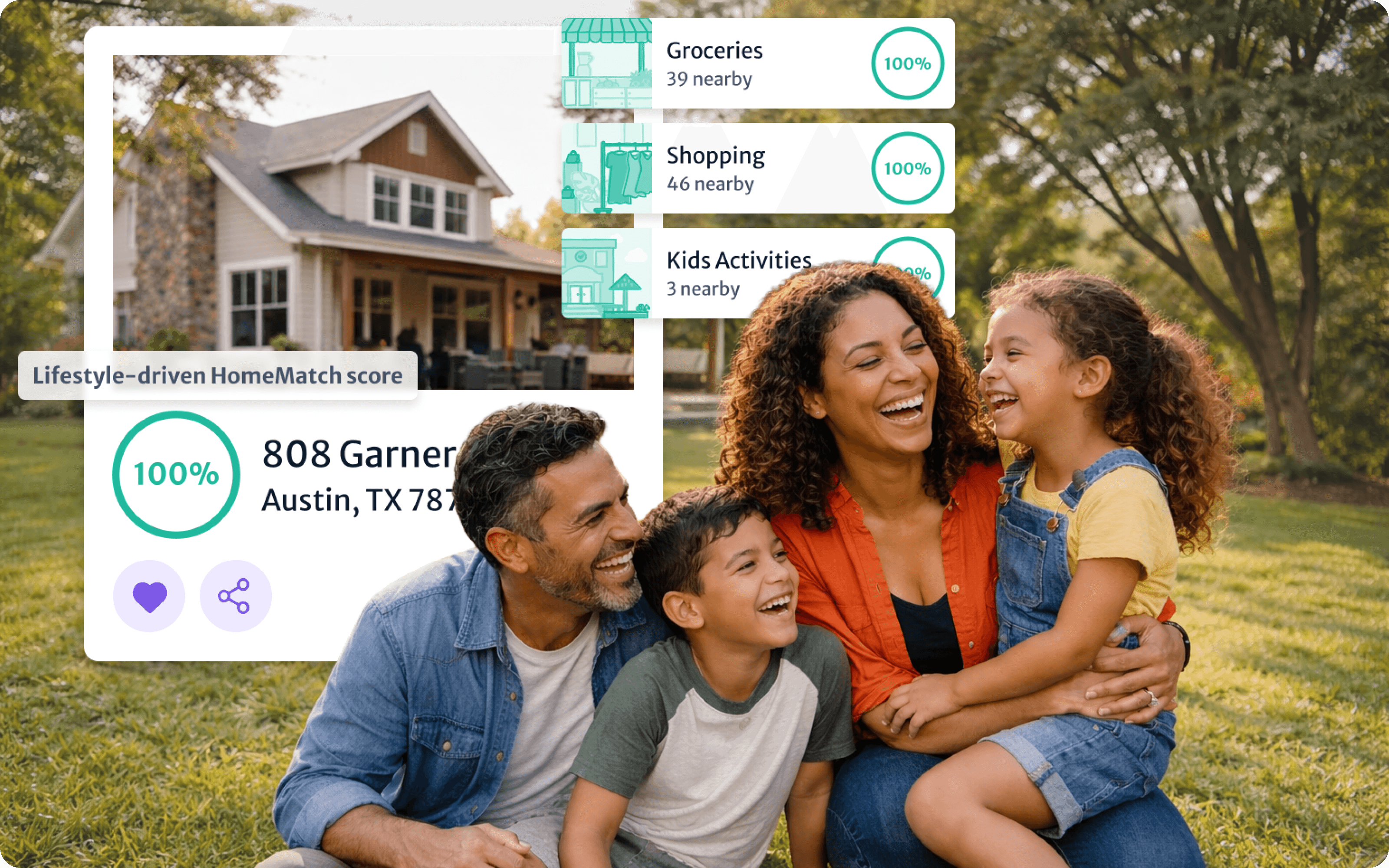
LandOnEarth matches home buyers to properties based on how they actually live — using conversational AI to capture lifestyle signals and rank homes by fit rather than spec match. Two U.S. design patents cover the HomeMatch interface.
LandOnEarth is an AI-powered real estate platform that supports home decisions through structured, explainable intelligence. As Head of Design, I translated the product vision into a scalable decision-support system — defining the signal architecture, conversational onboarding model, and UX patterns that anchored the platform from concept through live deployment across U.S. brokerages.
Problem
Home search tools optimize for specs, not lifestyle fit — leaving buyers with accurate filters but poor decisions, and agents without tools to have more meaningful conversations.
Real estate decision-making is fragmented and opaque.
Buyers struggle to translate lifestyle needs into structured criteria.
Agents rely on static filtering tools that overlook nuance.
AI-driven recommendations often lack transparency, reducing trust.
The challenge was not simply implementing AI — it was designing a system that made AI legible, actionable, and embedded into real-world decision workflows.
Approach
Three layers: capture lifestyle signals conversationally, synthesize them into a structured HomeMatch profile, then rank properties by lifestyle alignment rather than feature match.
I structured LandOnEarth as a cohesive decision-support architecture built across three core layers:
Signal Capture
Conversational AI translates qualitative lifestyle preferences into structured, quantifiable signals.
Profile Synthesis
Signals are synthesized into a dynamic HomeMatch profile that defines decision criteria at a system level.
Property Alignment
Listings are ranked by quantified lifestyle alignment, prioritizing overall fit over isolated features.
Guiding principles included:
Design for decisions, not data
Make AI explainable and trustworthy
Reduce cognitive load in complex workflows
Establish scalable design and identity foundations early
By aligning product architecture and brand expression, the system communicated intelligence and reliability as core attributes of the experience.
Key Design Decisions
Three decisions shaped the system: making AI reasoning visible rather than just accurate, using conversational onboarding to preserve qualitative signal that filter inputs destroy, and designing the HomeMatch profile to be useful to agents — not just buyers.
Designing trust into an AI-driven recommendation. The central risk in an AI-powered home matching product is that users don't trust the output — especially when the stakes are as high as a home purchase. An unexplained recommendation, no matter how accurate, creates anxiety rather than confidence. The critical design decision was to make the reasoning behind every recommendation visible: surfacing which lifestyle signals drove a property's match percentage, and which factors were creating misalignment. This transparency wasn't just a UX feature — it was the mechanism that made the AI feel like a decision-support tool rather than a black box.
Converting qualitative lifestyle preferences into structured data without losing nuance. The core technical challenge was that the signals that actually drive good home decisions — "I want to live somewhere walkable but quiet," "we have two dogs and a toddler" — are inherently qualitative and conversational. The design decision was to build a conversational onboarding model that gathered these signals in natural language and translated them into a structured profile behind the scenes, rather than forcing users into static filter inputs that would strip the nuance out. The constraint this solved was that traditional search UI (beds/baths/price) systematically excludes the signals that most predict long-term satisfaction.
Designing for real estate agents as a parallel user, not an afterthought. Early in the project it became clear that buyers rarely navigate high-stakes home decisions alone — agents are almost always in the loop. Rather than designing purely for the end buyer and hoping agents would adapt, I architected the information model to be legible and useful to agents reviewing a client's HomeMatch profile. This meant the system needed to communicate not just recommendations, but the reasoning behind them in language an agent could use in a conversation with their client.
Impact & Outcomes
Deployed across U.S. brokerages, with 2 granted U.S. design patents covering the HomeMatch interface and early behavioral data validating the lifestyle-alignment model.
The platform shipped with early users actively engaging with the AI-driven onboarding flow, with initial behavioral data being collected to inform continued iteration.
2 granted U.S. design patents (D879,803 · D879,804) covering the HomeMatch interface
Shipped with early users completing conversational onboarding and receiving ranked property recommendations
Initial engagement signals validating the core lifestyle-to-property alignment model
Scalable UX foundations supporting continued product iteration
The patents reflect that the HomeMatch interface was distinctive enough to merit design protection — a strong signal of the foundational design work that anchored the platform.
What I'd do differently
I'd have designed an agent-facing view of the HomeMatch profile much earlier in the product roadmap. The conversational onboarding was built primarily for the buyer, but home purchases almost never happen without an agent in the loop — and agents needed a format designed for their workflow, not a screen-share of the buyer UI. In retrospect, making the HomeMatch profile legible and discussable for agents from the beginning would have accelerated adoption through the brokerage channel significantly, since agents are the actual distribution path to buyers.
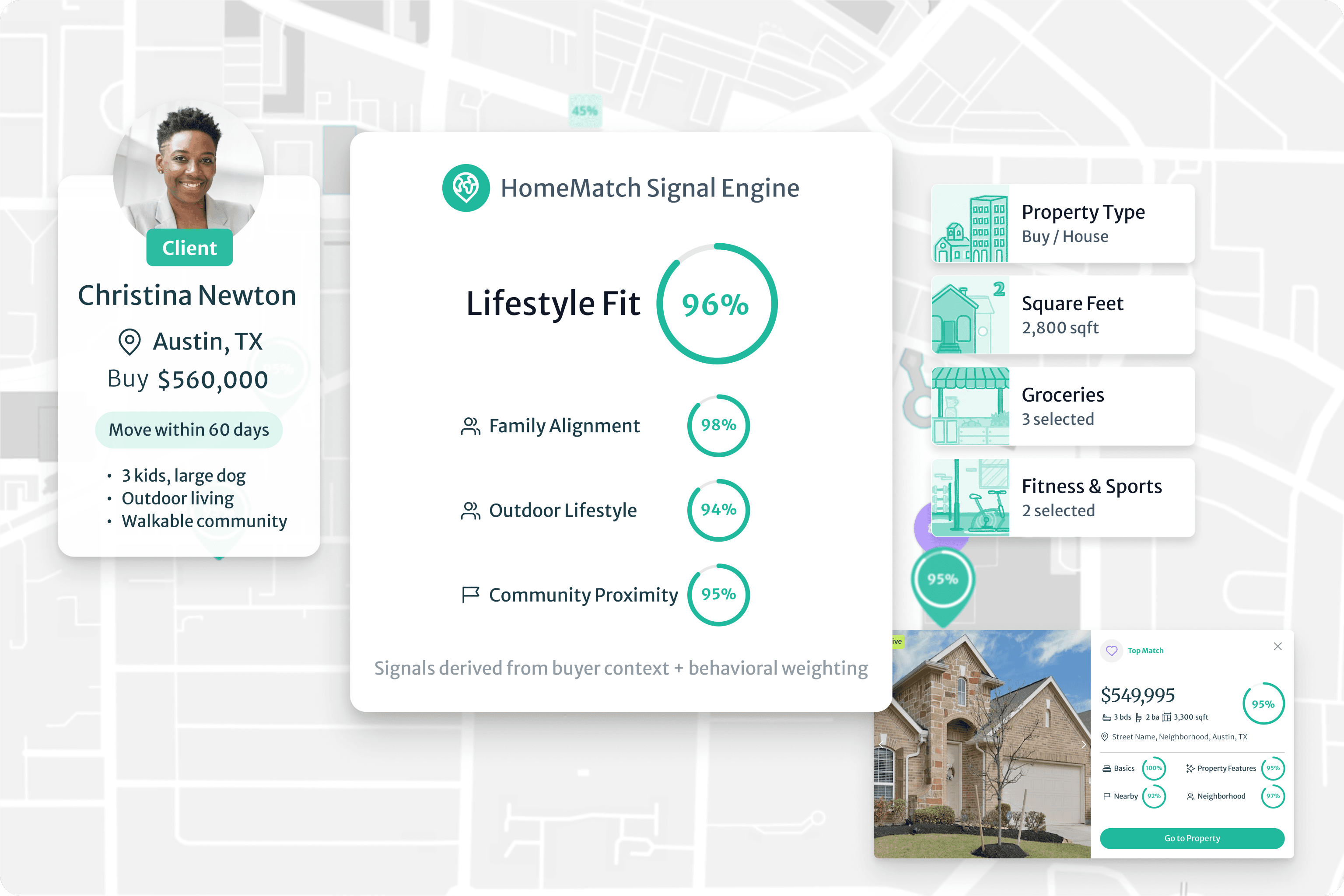
Predictive insights and buyer context brought together into a single decision-support experience.
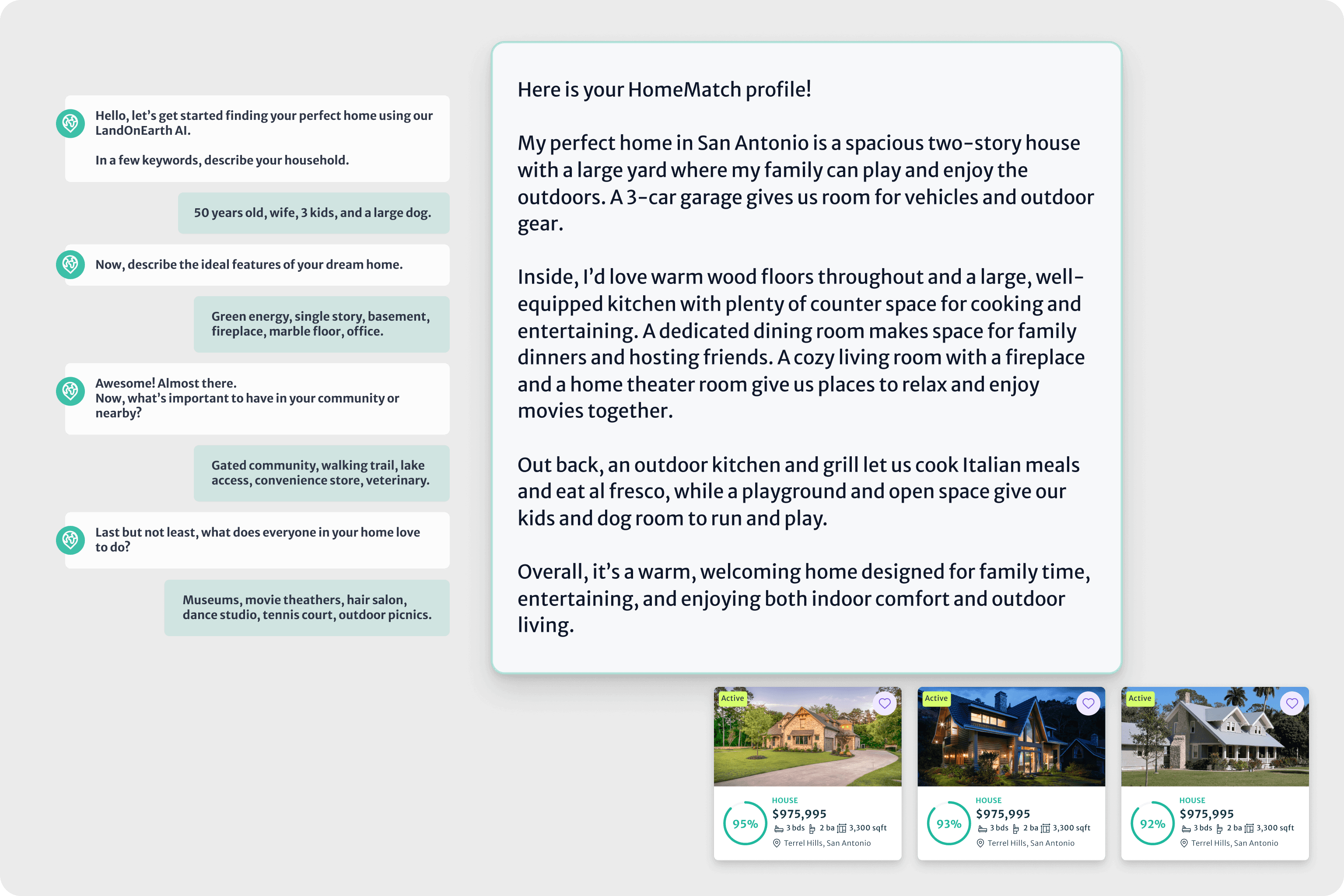
Conversational AI captures lifestyle, family, and activity preferences, transforming qualitative input into a structured HomeMatch profile that defines what “the right home” actually means for each user.
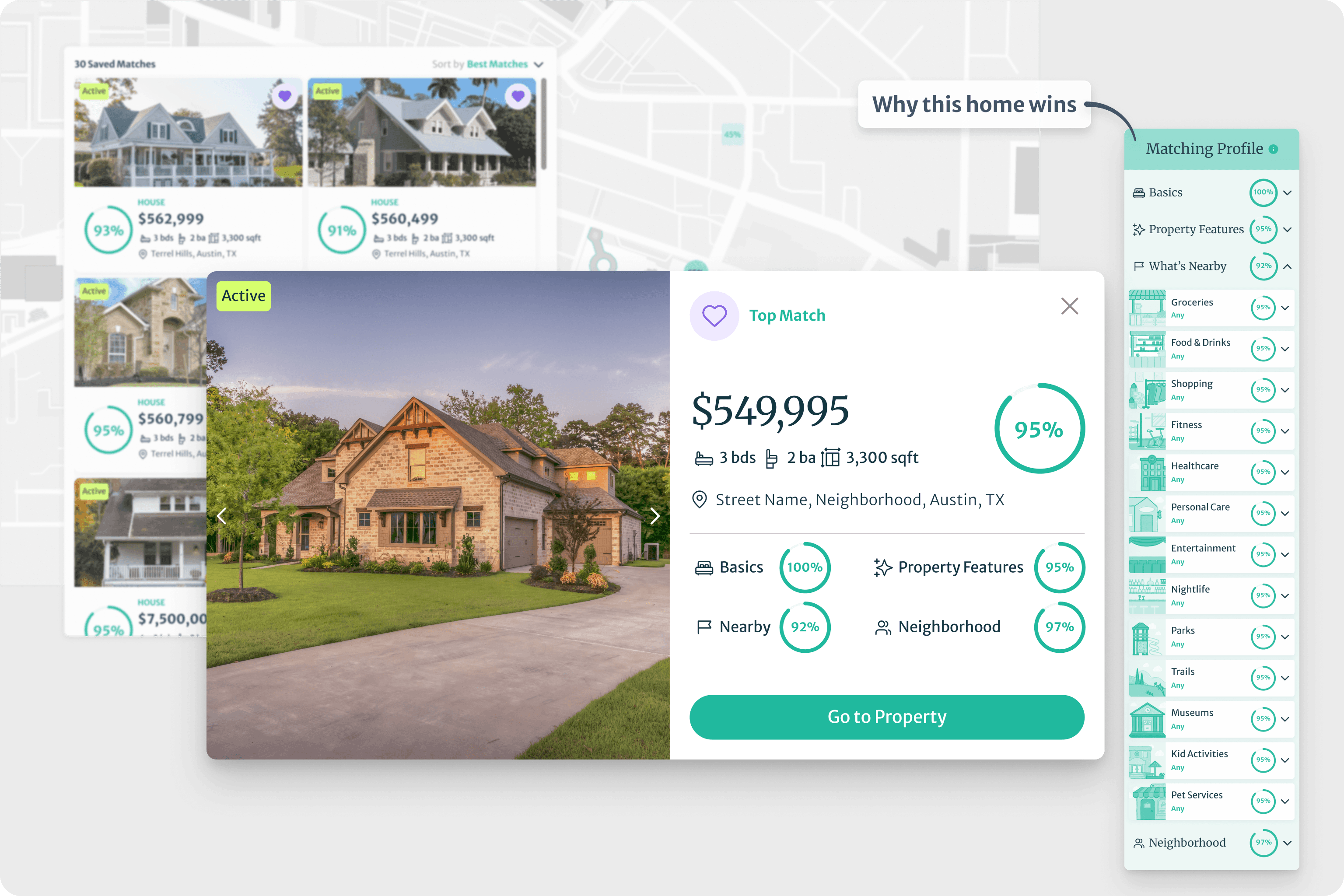
Properties are ranked by HomeMatch percentage, prioritizing overall lifestyle fit based on family needs, pets, and activities—helping users evaluate tradeoffs and focus on the homes most aligned with how they actually live.
Let’s build intelligent systems together.
Open to Head of Product Design and Director of Product Design roles across AI, fintech, infrastructure, and complex platforms.