Frictionless

AI-powered capital intelligence platform aligning startups, investors, and accelerators through structured evaluation systems.
AI Systems

AI Systems

Capital Intelligence

Capital Intelligence

Dual-Sided Platform

Dual-Sided Platform

Overview

Frictionless is an AI-enabled capital intelligence platform designed to improve how startups are evaluated, matched, and supported across investors, funds, and accelerators.

As Chief Product Officer, I lead product strategy, system architecture, and design execution — translating institutional investment workflows into a structured AI-driven evaluation and matching platform.

The system moves beyond simple matching. It evaluates startup readiness, aligns founders with investor thesis criteria, and provides structured pathways for improving performance and revenue outcomes beyond funding.

Frictionless was designed not merely as a marketplace, but as an evaluation infrastructure layer for early-stage capital ecosystems.

Role

Chief Product Officer

  • Defined product vision, AI evaluation architecture, and system strategy

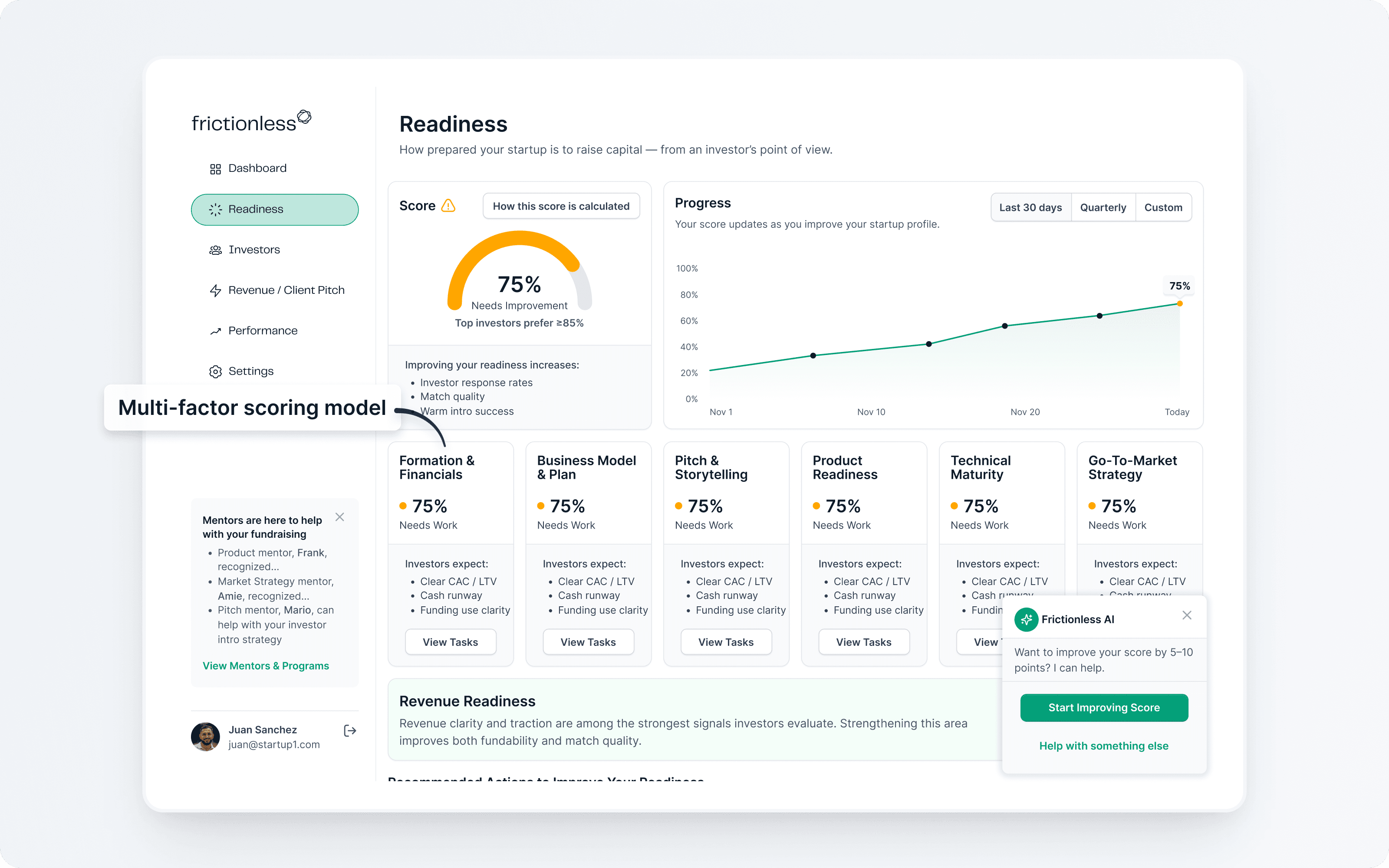
  • Designed structured startup Readiness Score framework

  • Architected investor thesis alignment and matching logic

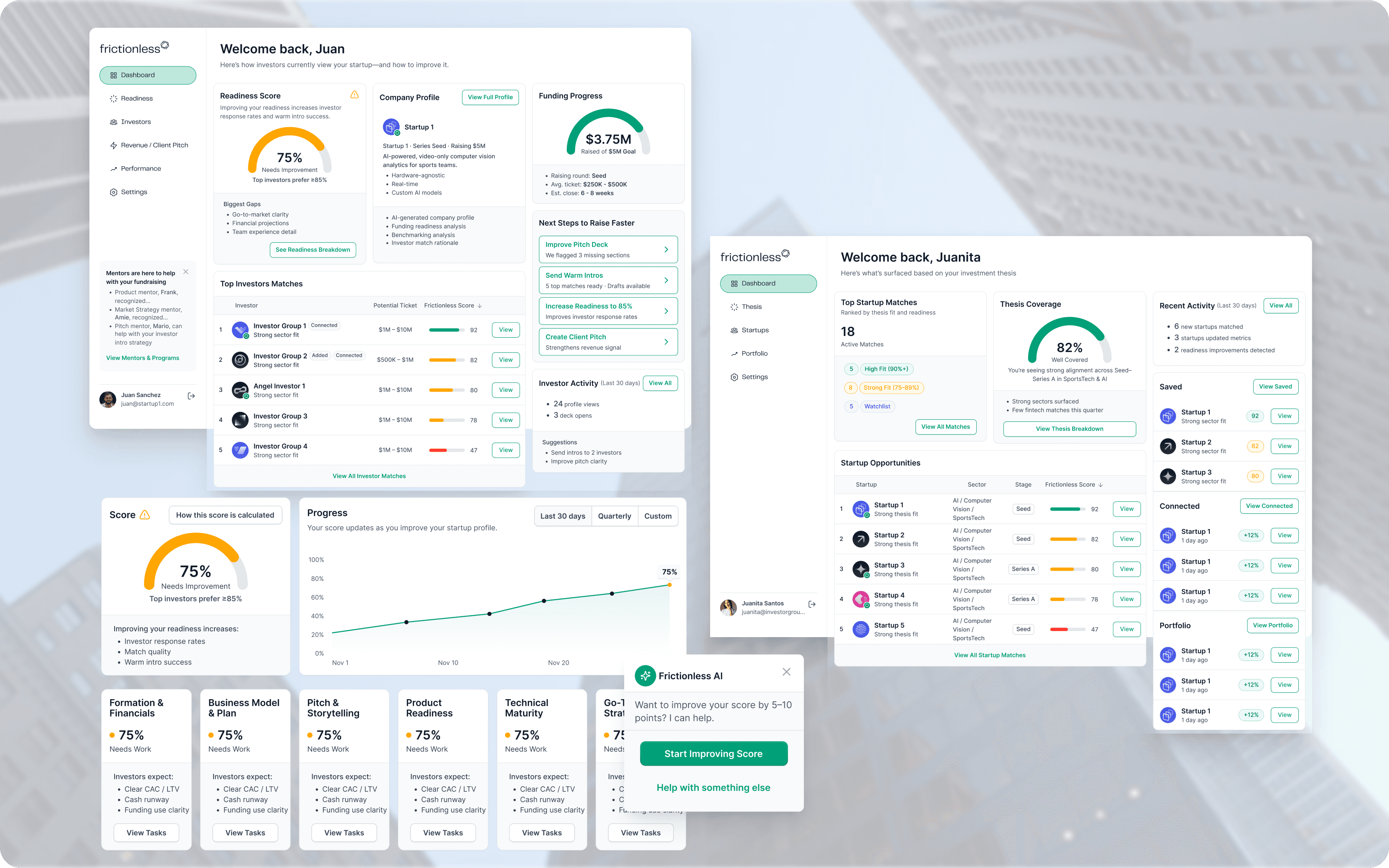
  • Built dual-sided dashboards for startups and institutional capital partners

  • Structured onboarding workflows powered by AI data extraction

  • Established product and identity systems aligned with institutional positioning

  • Led cross-functional alignment across engineering, operations, and executive stakeholders

While operating within a lean team, I own end-to-end product definition — from system modeling and UX architecture to high-fidelity design and strategic roadmap development.

Chief Product Officer

  • Defined product vision, AI evaluation architecture, and system strategy

  • Designed structured startup Readiness Score framework

  • Architected investor thesis alignment and matching logic

  • Built dual-sided dashboards for startups and institutional capital partners

  • Structured onboarding workflows powered by AI data extraction

  • Established product and identity systems aligned with institutional positioning

  • Led cross-functional alignment across engineering, operations, and executive stakeholders

While operating within a lean team, I own end-to-end product definition — from system modeling and UX architecture to high-fidelity design and strategic roadmap development.

Chief Product Officer

  • Defined product vision, AI evaluation architecture, and system strategy

  • Designed structured startup Readiness Score framework

  • Architected investor thesis alignment and matching logic

  • Built dual-sided dashboards for startups and institutional capital partners

  • Structured onboarding workflows powered by AI data extraction

  • Established product and identity systems aligned with institutional positioning

  • Led cross-functional alignment across engineering, operations, and executive stakeholders

While operating within a lean team, I own end-to-end product definition — from system modeling and UX architecture to high-fidelity design and strategic roadmap development.

Problem

Early-stage capital allocation is fragmented and inefficient.

Investors evaluate startups through inconsistent criteria.
Startups lack structured insight into their readiness and alignment gaps.
Accelerators struggle to identify high-fit candidates at scale.

Evaluation processes rely heavily on manual review, subjective judgment, and disconnected tools.

The challenge was not simply building a matching tool — it was designing a scalable evaluation system capable of:

  • Structuring qualitative startup data

  • Translating investor thesis criteria into machine-readable logic

  • Generating transparent readiness signals

  • Supporting founders beyond capital introduction

The opportunity was to create an institutional-grade intelligence layer for startup evaluation and growth.

Early-stage capital allocation is fragmented and inefficient.

Investors evaluate startups through inconsistent criteria.
Startups lack structured insight into their readiness and alignment gaps.
Accelerators struggle to identify high-fit candidates at scale.

Evaluation processes rely heavily on manual review, subjective judgment, and disconnected tools.

The challenge was not simply building a matching tool — it was designing a scalable evaluation system capable of:

  • Structuring qualitative startup data

  • Translating investor thesis criteria into machine-readable logic

  • Generating transparent readiness signals

  • Supporting founders beyond capital introduction

The opportunity was to create an institutional-grade intelligence layer for startup evaluation and growth.

Early-stage capital allocation is fragmented and inefficient.

Investors evaluate startups through inconsistent criteria.
Startups lack structured insight into their readiness and alignment gaps.
Accelerators struggle to identify high-fit candidates at scale.

Evaluation processes rely heavily on manual review, subjective judgment, and disconnected tools.

The challenge was not simply building a matching tool — it was designing a scalable evaluation system capable of:

  • Structuring qualitative startup data

  • Translating investor thesis criteria into machine-readable logic

  • Generating transparent readiness signals

  • Supporting founders beyond capital introduction

The opportunity was to create an institutional-grade intelligence layer for startup evaluation and growth.

Approach

I structured Frictionless as a capital intelligence architecture composed of four core layers.

AI Data Extraction & Structuring

Automated ingestion of pitch decks, websites, and startup data into structured evaluation fields.

Readiness Evaluation Layer

Defined a proprietary Readiness Score framework translating qualitative signals into quantifiable metrics across product, traction, team, and market criteria.

Thesis Alignment Engine

Architected matching logic aligning startup profiles with investor thesis parameters, generating structured compatibility percentages.

Growth & Performance Layer

Designed task and improvement workflows enabling startups to increase readiness scores and drive operational performance beyond funding.

Guiding principles:

  • Make evaluation transparent and explainable

  • Translate subjective criteria into structured systems

  • Reduce friction in institutional workflows

  • Design scalable architecture from inception

The system was built to support iteration while maintaining institutional-grade rigor and clarity.

I structured Frictionless as a capital intelligence architecture composed of four core layers.

AI Data Extraction & Structuring

Automated ingestion of pitch decks, websites, and startup data into structured evaluation fields.

Readiness Evaluation Layer

Defined a proprietary Readiness Score framework translating qualitative signals into quantifiable metrics across product, traction, team, and market criteria.

Thesis Alignment Engine

Architected matching logic aligning startup profiles with investor thesis parameters, generating structured compatibility percentages.

Growth & Performance Layer

Designed task and improvement workflows enabling startups to increase readiness scores and drive operational performance beyond funding.

Guiding principles:

  • Make evaluation transparent and explainable

  • Translate subjective criteria into structured systems

  • Reduce friction in institutional workflows

  • Design scalable architecture from inception

The system was built to support iteration while maintaining institutional-grade rigor and clarity.

I structured Frictionless as a capital intelligence architecture composed of four core layers.

AI Data Extraction & Structuring

Automated ingestion of pitch decks, websites, and startup data into structured evaluation fields.

Readiness Evaluation Layer

Defined a proprietary Readiness Score framework translating qualitative signals into quantifiable metrics across product, traction, team, and market criteria.

Thesis Alignment Engine

Architected matching logic aligning startup profiles with investor thesis parameters, generating structured compatibility percentages.

Growth & Performance Layer

Designed task and improvement workflows enabling startups to increase readiness scores and drive operational performance beyond funding.

Guiding principles:

  • Make evaluation transparent and explainable

  • Translate subjective criteria into structured systems

  • Reduce friction in institutional workflows

  • Design scalable architecture from inception

The system was built to support iteration while maintaining institutional-grade rigor and clarity.

Key Design Decisions

Making AI scoring explainable, not just accurate. Early in the process, the natural instinct was to optimize the Readiness Score for precision — surface the most accurate signal and let the output speak for itself. I pushed back on this. For institutional capital partners, a score without transparency is a score without trust. The critical design decision was to architect the scoring layer as an explainable system — surfacing not just a number, but the underlying signals and gaps driving it. This made the platform usable for investors who needed to defend their screening decisions internally, not just act on them.

Designing for both sides of an inherently asymmetric relationship. Startups and investors have fundamentally different mental models, vocabularies, and goals. A dashboard that works for a founder evaluating their own readiness looks nothing like one that works for a fund manager screening a cohort. Rather than defaulting to a single unified interface, I architected dual-sided dashboards with distinct information hierarchies — while ensuring the underlying data model remained consistent. The constraint that forced this was the realization that building for "both" without acknowledging the asymmetry produces something that works well for neither.

Sequencing onboarding to reduce the cold-start problem. A matching platform is only as useful as the quality of data it has to work with. The risk at launch was that founders would submit incomplete or surface-level information, degrading match quality and eroding investor confidence early. I designed the AI-powered onboarding to extract and structure data from existing materials — pitch decks, websites, prior documents — before asking founders to fill anything in manually. This reduced the activation burden and improved data completeness from the start.

Making AI scoring explainable, not just accurate. Early in the process, the natural instinct was to optimize the Readiness Score for precision — surface the most accurate signal and let the output speak for itself. I pushed back on this. For institutional capital partners, a score without transparency is a score without trust. The critical design decision was to architect the scoring layer as an explainable system — surfacing not just a number, but the underlying signals and gaps driving it. This made the platform usable for investors who needed to defend their screening decisions internally, not just act on them.

Designing for both sides of an inherently asymmetric relationship. Startups and investors have fundamentally different mental models, vocabularies, and goals. A dashboard that works for a founder evaluating their own readiness looks nothing like one that works for a fund manager screening a cohort. Rather than defaulting to a single unified interface, I architected dual-sided dashboards with distinct information hierarchies — while ensuring the underlying data model remained consistent. The constraint that forced this was the realization that building for "both" without acknowledging the asymmetry produces something that works well for neither.

Sequencing onboarding to reduce the cold-start problem. A matching platform is only as useful as the quality of data it has to work with. The risk at launch was that founders would submit incomplete or surface-level information, degrading match quality and eroding investor confidence early. I designed the AI-powered onboarding to extract and structure data from existing materials — pitch decks, websites, prior documents — before asking founders to fill anything in manually. This reduced the activation burden and improved data completeness from the start.

Making AI scoring explainable, not just accurate. Early in the process, the natural instinct was to optimize the Readiness Score for precision — surface the most accurate signal and let the output speak for itself. I pushed back on this. For institutional capital partners, a score without transparency is a score without trust. The critical design decision was to architect the scoring layer as an explainable system — surfacing not just a number, but the underlying signals and gaps driving it. This made the platform usable for investors who needed to defend their screening decisions internally, not just act on them.

Designing for both sides of an inherently asymmetric relationship. Startups and investors have fundamentally different mental models, vocabularies, and goals. A dashboard that works for a founder evaluating their own readiness looks nothing like one that works for a fund manager screening a cohort. Rather than defaulting to a single unified interface, I architected dual-sided dashboards with distinct information hierarchies — while ensuring the underlying data model remained consistent. The constraint that forced this was the realization that building for "both" without acknowledging the asymmetry produces something that works well for neither.

Sequencing onboarding to reduce the cold-start problem. A matching platform is only as useful as the quality of data it has to work with. The risk at launch was that founders would submit incomplete or surface-level information, degrading match quality and eroding investor confidence early. I designed the AI-powered onboarding to extract and structure data from existing materials — pitch decks, websites, prior documents — before asking founders to fill anything in manually. This reduced the activation burden and improved data completeness from the start.

Impact & Outcomes

The platform is live and actively onboarding its first institutional partners, with an initial pilot cohort underway across investors and accelerators.

  • Established structured AI evaluation framework for early-stage capital ecosystems

  • Enabled transparent Readiness Score modeling across startup cohorts

  • Defined thesis-alignment matching logic for investors and accelerators

  • Structured improvement pathways driving startup performance beyond capital access

  • Positioned Frictionless as an institutional-grade evaluation infrastructure

The platform created a scalable foundation for aligning startups and capital through structured intelligence rather than manual review alone.

The platform is live and actively onboarding its first institutional partners, with an initial pilot cohort underway across investors and accelerators.

  • Established structured AI evaluation framework for early-stage capital ecosystems

  • Enabled transparent Readiness Score modeling across startup cohorts

  • Defined thesis-alignment matching logic for investors and accelerators

  • Structured improvement pathways driving startup performance beyond capital access

  • Positioned Frictionless as an institutional-grade evaluation infrastructure

The platform created a scalable foundation for aligning startups and capital through structured intelligence rather than manual review alone.

The platform is live and actively onboarding its first institutional partners, with an initial pilot cohort underway across investors and accelerators.

  • Established structured AI evaluation framework for early-stage capital ecosystems

  • Enabled transparent Readiness Score modeling across startup cohorts

  • Defined thesis-alignment matching logic for investors and accelerators

  • Structured improvement pathways driving startup performance beyond capital access

  • Positioned Frictionless as an institutional-grade evaluation infrastructure

The platform created a scalable foundation for aligning startups and capital through structured intelligence rather than manual review alone.

Structured Readiness Score framework translating qualitative startup signals into quantifiable evaluation metrics.
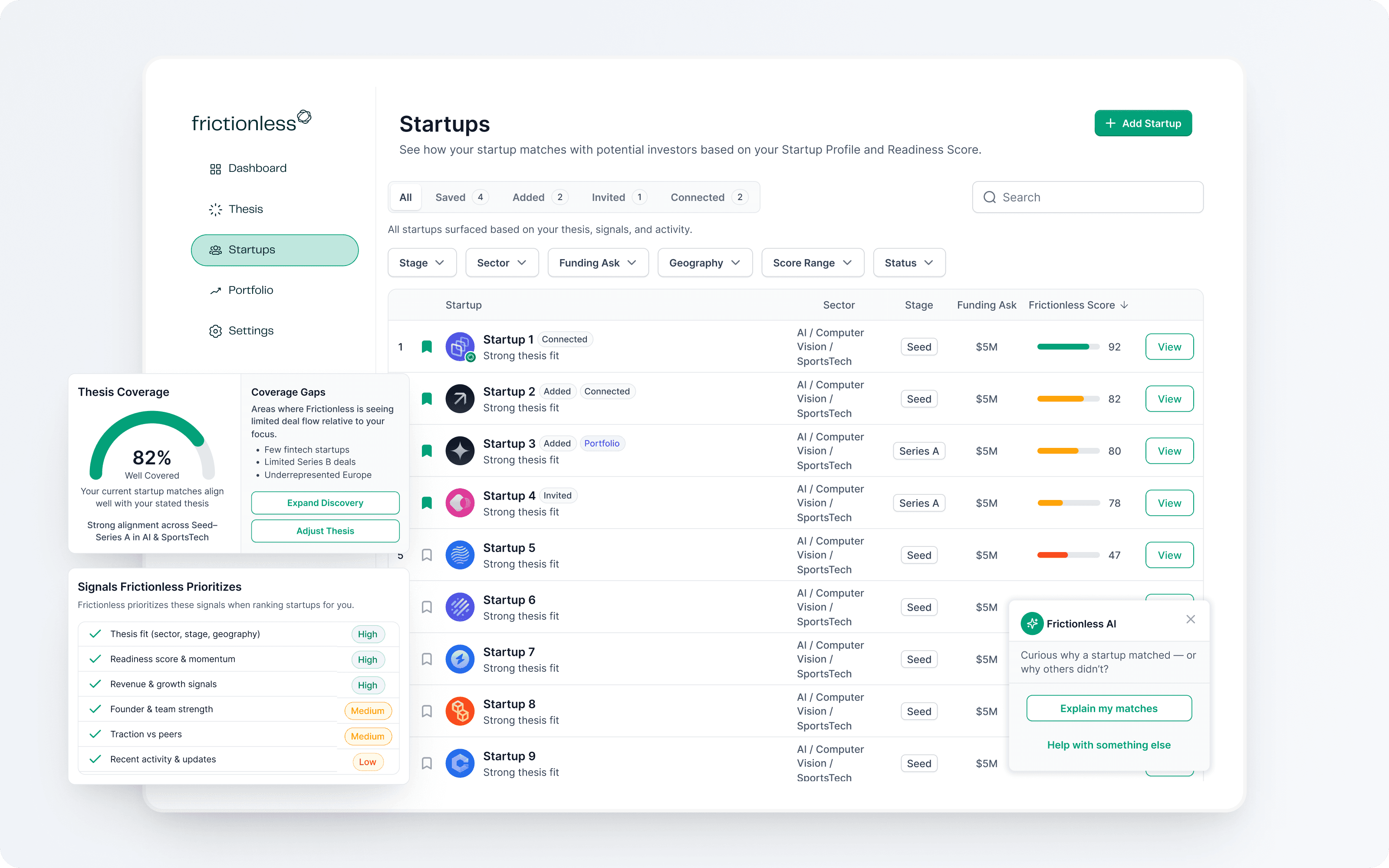
Thesis alignment engine matching startups to investors through structured compatibility modeling.

Conversational AI onboarding transforming unstructured pitch materials into structured evaluation data.
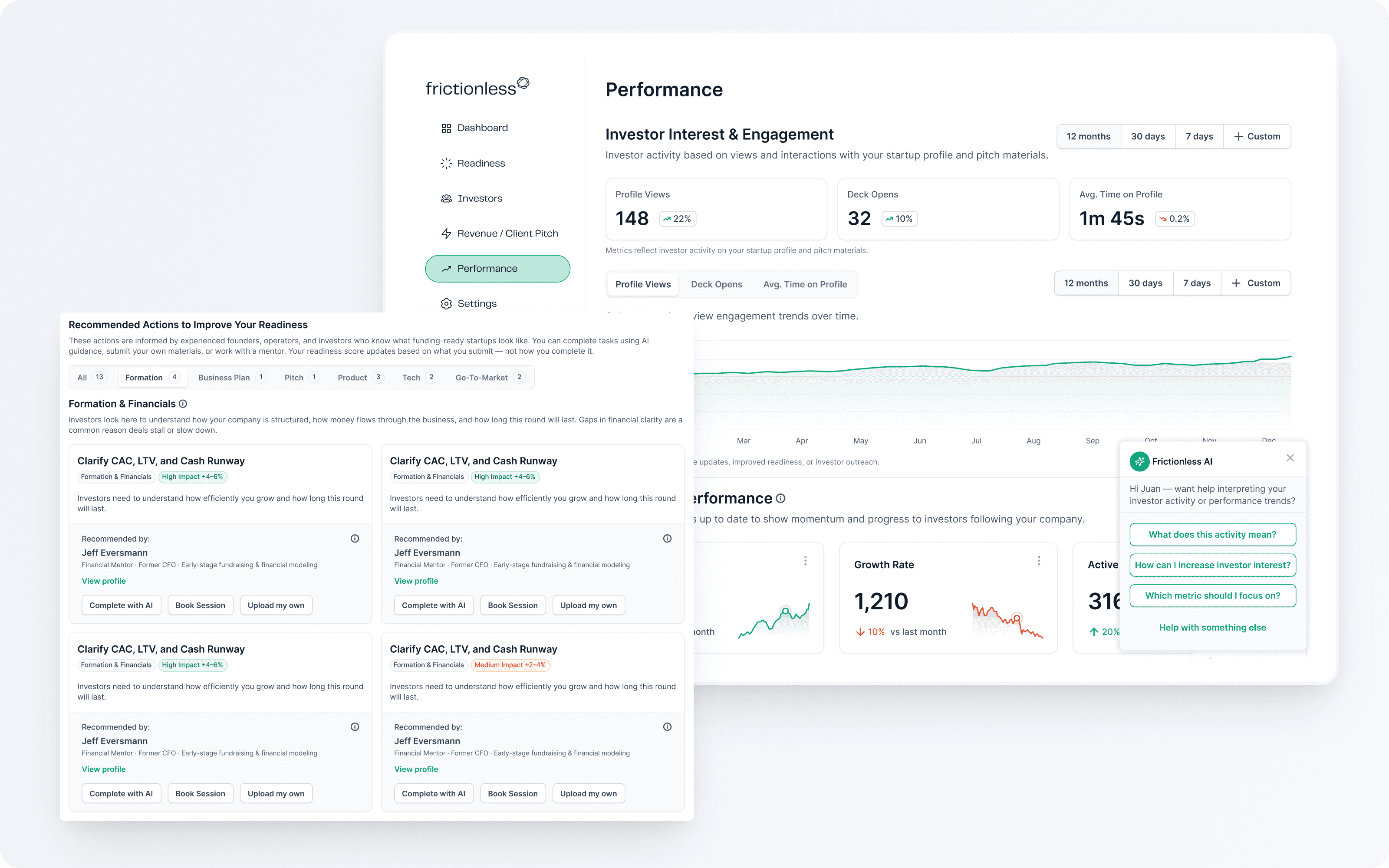
Growth workflows enabling startups to improve readiness scores and operational performance beyond capital introduction.
Let’s build intelligent systems together.

Open to senior product design and leadership opportunities across AI, infrastructure, and complex platforms.

Frank Sandoval

Designing intelligent product systems.

© Frank Sandoval
Designed and built with intention.

Frank Sandoval

Designing intelligent product systems.

© Frank Sandoval
Designed and built with intention.

Frank Sandoval

Designing intelligent product systems.

© Frank Sandoval
Designed and built with intention.